Disclaimer
Many of my essays are quite old. They were, in effect, written by a person who no longer exists in that my views, beliefs, and overall philosophy have grown and evolved over the years. Consequently, if I were to write on the same topics again, the resulting essays might differ significantly from their current versions. Rather than edit my essays to remain contemporary with my views, I have chosen to preserve them as a record of my past inclinations and writing style. Thank you for understanding.
|
December 2003
Digital Photography
An Incredible Example of the Pace of Modern Technological Change
Brief Description
I created this webpage for one purpose. It drives me crazy how naive most people are about the pace of technological change in the modern world. People think artificial intelligence is centuries away, that traveling in space on a regular basis is the dream of future generations, that the world we see around us is a good approximation of the world we will live in a century from now, and apparantly that "film will never die", that often-heard cry of the nastalgic movie-director and romantic photographer alike who together hark for a time when visual media was pure and free of the ills of technological dystopia. The problem is, people do not comprehend the increasing speed with which technology evolves. This webpage attempts to exemplify this trend.
Full Description
Sometime in mid 2002, approximately, I was having a conversation with a friend about photography. This friend is an avid photographer (it might have been her major, I don't recall), and I remember her going on about how film would never die, and about how digital photography would never equal film photography. She commented on the unimpressive resolution and high cost of such equipment, and on the unprofessional utility of most contemporary digital cameras at the time, which did not even include interchangable lenses or SLR-type action among other ailments. This conversation really irritated me because I could barely have imagined such a myopic view of the world, had it not been presented to me directly by this person. In recent years SLR-type digital cameras and interchangable lenses have come into being. Likewise, the resolution has continued to increase while the price has continued to decrease.
In late 2003, I got the idea to collect as much information on digital cameras and their history as possible and to present that information in a clear graphical context that would illustrate just how incredibly fast this technology has gone from mere emergence to complete domination of the industry. The plain and simple fact is that digital photography went from a nonexistent medium to a common medium in about seven years. According to the graphs presented below, it is my prediction that digital photography will dominate film photography by New Year's 2008, and that it will all but wipe out film photography by New Year's 2010, less than fifteen years after its inception.
The vast majority of the data presented on this webpage was collected from http://www.dpreview.com/reviews/timeline.asp, which has amassed historical data on the evolution of the digital camera for several years. Despite some huge holes in their dataset (many of their archived camera model data do not include introductory prices for the models), there is still an abundance of measurable and quantifiable data available. One thing worth realizing is that the source mentioned above archives "serious" cameras only. 640x480 cameras (the .3 megapixel categories in the following graphs) became so cheap and so ubiquituous after 2000 that they were no longer included in the timeline mentioned above. Instead, they were relegated to the status of trinkets found on keychains, mp3-players, and cell-phones. The same fate probably awaits 1.2 megapixel cameras as well.
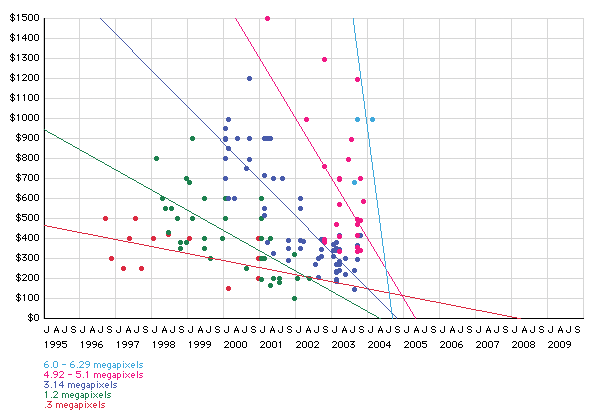
Release-Date Price of Digital Cameras Vs. Time, plotted for five sensor sizes (straight line fit):
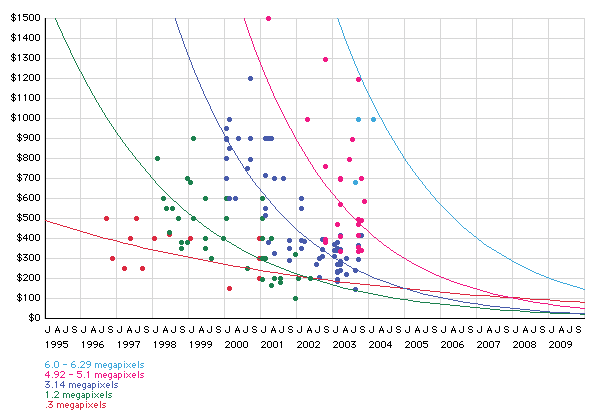
The graphs above and below show the same data with different line and curve fitting algorithms applied to the points, each point representing a single camera model. It should be noted that in the 6 megapixel and above category a few outliers exist prior to to 2003, but were so expensive that they did not easily fit on the graph. It is also worth noting that as of the end of 2003 there were a few 8 megapixel models released. I did not graph them because there aren't enough 8 megapixel models to estimate trends for them yet. However, the introductory price of one of these 8 megapixel cameras was a mere $999, which serves to point out the most extraordinary observation about these two graphs, which is not the rapid decrease in price for any given sensor size, but is the increasing rate of decrease in price as large sensor sizes are produced.
In other words, as sensor size increases, it is easy to observe from these graphs that the price of a corresponding camera comes down more and more quickly over time. This suggests that in the future, as larger sensors are used in digital cameras, that the time between the original introduction of cameras with a particular sensor size and the time when such cameras goes out of fashion will shrink nearly to zero, which follows on to suggest that digital cameras will be virtually released at low price even for new models in the future.
Release-Date Price of Digital Cameras Vs. Time, plotted for five sensor sizes (exponential fit):
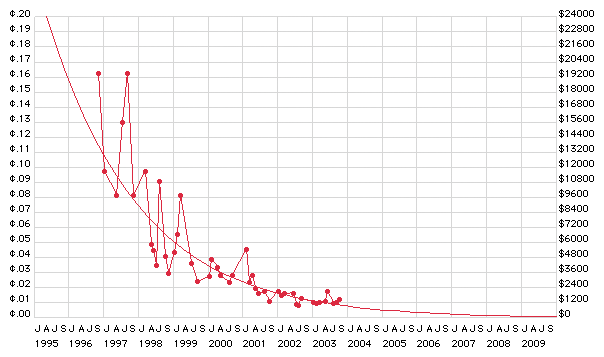
Another way to gauge the progress of this technology is to look at the average cost of a digital camera with respect to its sensor size. To normalize across cameras with different sensor sizes, the following graph shows how much a single pixel on a sensor costs over time on the left axis and how much that cost extends to a theoretical 12 megapixel camera on the right axis. The prediction made by the curve is that sensor pixels will decrease in price by a factor of eight or more between 2004 and 2010, resulting in 12 megapixel cameras in the $100 price range by 2010. A 12 megapixel camera would have a resolution of 4000x3000 pixels which would produce a 13.3 x 10 inch print at 300 dpi or a 26.7 x 20 inch print at 150 dpi.
Release-Date Price Per Sensor Pixel (left axis) and Per 12 megapixels (right axis) Vs. Time (exponential fit):
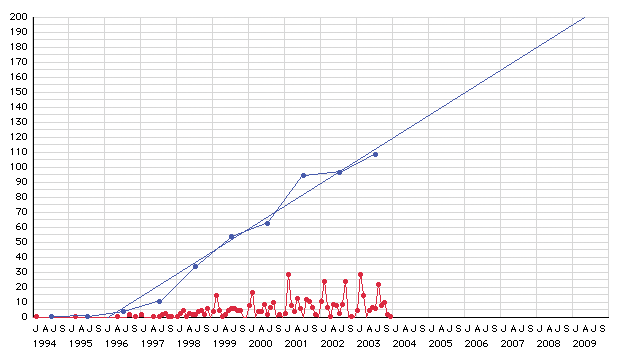
Another way to measure the proliferation of a new technology is to observe the number of individual models being created by various companies across the market as the market grows. The following graph shows the number of models of digital cameras released on a monthly basis (red) and yearly basis (blue) with an extrapolation in the annual production that reaches 200 models per year by 2009. (The line fit discards the single model released in1994 incidently). The prediction is that the number of new models created per year should double between 2003 and 2009. It is interesting to note that I tried curve-fitting with an exponential and a parabola and both curves hit 200 even earlier than the straight-line fit, which suggests that this graph is conservative in its projection.
Number of New Digital Camera Models Vs. Time (straight line fit):
I would really like to hear what people think of this. If you prefer private feedback, you can email me at kwiley@keithwiley.com. Alternatively, the following form and comment section is available.
Comments
|
|
|
|
|
| Name: | Moike |
Date/Time: | 2022/01/28 19:44:01 GMT |
PS. found your site for digital time lapse astrophotography
placing a simple barn-door equatorial mount onto a $10 (CDN blowout "barn" sale) Celestron tripod
optical component is an OmniVision OV7620 "raw" CMOS imaging device (no FIFO buffering like OV7670)
the trick is to see how long the "shutter" can be kept open and if a faint signal can be recorded
the other "trick" is simply soft/hard ware interfacing it
"simpler" and also; will use film camera too with print film (slide chrome film gone way of dodo and woolly mammoth), w/o printing, digitally inverting, negatively, the negatives (nor maybe not ;)
|
|
| Name: | Moike |
Date/Time: | 2022/01/28 19:06:11 GMT |
circa Jan 2022 ... 2 yrs after seeing clearing in 2020 ... still no 100K electronic displays, projectors or monitors
and a "quality" 35mm slide can be used for a "quality" 24 inch x 36 inch print (nominally 1 mm -> 1 inch ie. enlarged 25.4 X)
@ 300 dpi (dots per inch) this print is crudely 2 x 3 x 12 x 12 x 300 x 300 = 864 x 90,000 or ~80,000,000 dots
crudely, if a dot approximates a pixel (or vice versa), then 80 mega pixels is required to do the "same" digitally
caveat: looking at interlaced digital equipment pitch and pixel size at large resolutions, known as Big Dot Interlaced or BDI,
may manifest also as ... beady eye
|
|
| Name: | Srakotraqu |
Date/Time: | 2012/06/02 18:11:46 GMT |
Very interesting site
|
|
| Name: | Anonymous |
Date/Time: | 2012/03/27 15:54:51 GMT |
This is a very interesting study... just how much more do you think the average camera's megapixel count will increase by 2015?
|
|
| Name: | Keith |
Date/Time: | 2011/08/25 |
NOTE THAT ALL COMMENTS OLDER THAN THIS ONE PREDATE THE COMMENT SYSTEM. They originated as email feedback and have been retroactively converted to public comments to seed the new comment system. As such I have redacted them where appropriate for the purpose of preserving their anonymity.
|
|
| Name: | Anonymous |
Date/Time: | 2006/09/12 |
Keith,
Saw your site on price trends in digital cameras. Very useful info.
Have you done anything similar with video image sensors? e.g., what is trend in cost/pixel for various frame rates (e.g., 30 frames/second) for CMOS and CCD? I suppose it might be similar, although additional complexity might slow cost decreases.
|
|
| Name: | Anonymous |
Date/Time: | 2005/10/06 |
Keith - Are you still there? I ask that simply because I'm responding
to work you posted over a year ago, and you are very much aware that in
this day and age, that's a long time ago.
The graphs you show on this site are very interesting. But have you
looked at what happens to the display of data when you apply the work of
Everett Rogers and his followers to the analysis? I presume you are
familiar with "Diffusion of Technology" (1962) and the follow-up books
that were written on the subject, but if not, then if you applied the
cumulative curve S-shaped display to the data you would probably find
that your predictions are a bit exuberant. If each of the five chip
resolutions that you reference in this website is treated as a separate
technology and if each is considered as the "replacement technology" for
the previous one, then the interactions among the various chips, their
cost/benefit ratios, their life-cycles, and the technical limits of each
become apparent.
One of the things that Rogers does not discuss in his work is that every
technology has an asymptotic limit at the end of its production life.
Every technology reaches a point where no improvement can economically
occur regardless of how much money may be thrown at it. Film
photography is one such technology. It remained at a high plateau for
many years, but when a replacement technology was introduced for it
(digital photography) there is no way that any changes in silver-halide
based imaging could possibly salvage the industry. The point at which
the cost/benefit ratio of digital imaging surpasses film photography is
the point at which the old technology ceases to exist as an economic
entity.
Similar analysis can be applied to the switch from analog to digital
sound recording, storage, and reproduction. Obviously, there were a
number of changes and developments that occurred over the years in the
analog mode, but when the cost/benefit ratio of digital surpassed the
highest possible level of analog, the industry and the economy switched
over completely. That switch (as are all such) is irrevocable.
|
|
| Name: | Anonymous |
Date/Time: | 2004/07/28 |
Hi Keith,
I love your analysis of digital photography and the pace of technological advancement. The project is a brilliant idea and well executed.
Your report fits right in with a presentation I plan to give to my camera club [...]. Your analysis makes several of the points I wanted to convey, most importantly the rapid pace of evolution and the diminishing cost. We have a lot of incredible photographers who are shooting film and have no inkling of digital, but want to know something before the change from film is forced upon them.
I'm volunteering to give this one-time seminar, as all of the judges and presenters at our club are unpaid. Would you grant me permission to include your page as a reference and to show some of your graphs and conclusions? Tell me if there are any concerns about sharing it in this way. I'm sure the club members will be appreciative beneficiaries of your work on this project.
|
|
| Name: | Anonymous |
Date/Time: | 2004/04/24 |
Hi Keith:
I think your more than conservative in your projections. From one who is looking at his 67th birthday this year, it seems everything digital is on an exponential curve.
It's only a couple of years ago, to me, that the Tandy computer was the answer to home computing. You have no idea how fast all this is moving, at least from an old fart's perspective.
Yet, I spent 30 years in industrial electronics and I am still amazed how fast our knowledge base and technical skills are changing. I foresee the likes of electrical engineers never leaving school within a decade and a half.
Machines are "economically" nearing self repair. Man already replaces instead of repairs, so a machine can already do that, if we were to let it. The Japanese walking robot can now travel our pathways and replace the part and needs no time off.
How long can society afford to pay the high cost for human exchangers? Has our social morals kept pace with this rapidly changing technological world? I don't think so. So, what happens to the displaced and how will they survive?
Your questions and thoughts on digital cameras has far greater depths then the average person would wish to see.
Hell, I am running off at the keyboard. Another example of how a machine allows us to feel free to waste a few minutes.
I was researching CCD astrophotography software etc., so fell into your trap here.
Take care of what you ask for in replies!
|